YouTube for Business: What Your Like Count Isn't Telling You
Apr 14, 2026
YouTube for business is the content investment that keeps working after you hit publish, and it works in ways that most business owners never check. If you've been measuring your content's success by likes, comments, and follower counts, you've been reading the wrong report card. The real work is happening in search, and YouTube was built for it from the beginning.
My name is Kathy Sizemore. I'm a YouTube Strategist for Business Owners, and I've spent nearly 30 years running a family business in Southwest Riverside County. I've watched brilliant business owners give up on content because the numbers they were watching told them it wasn't working. The numbers were fine. They were just watching the wrong ones.
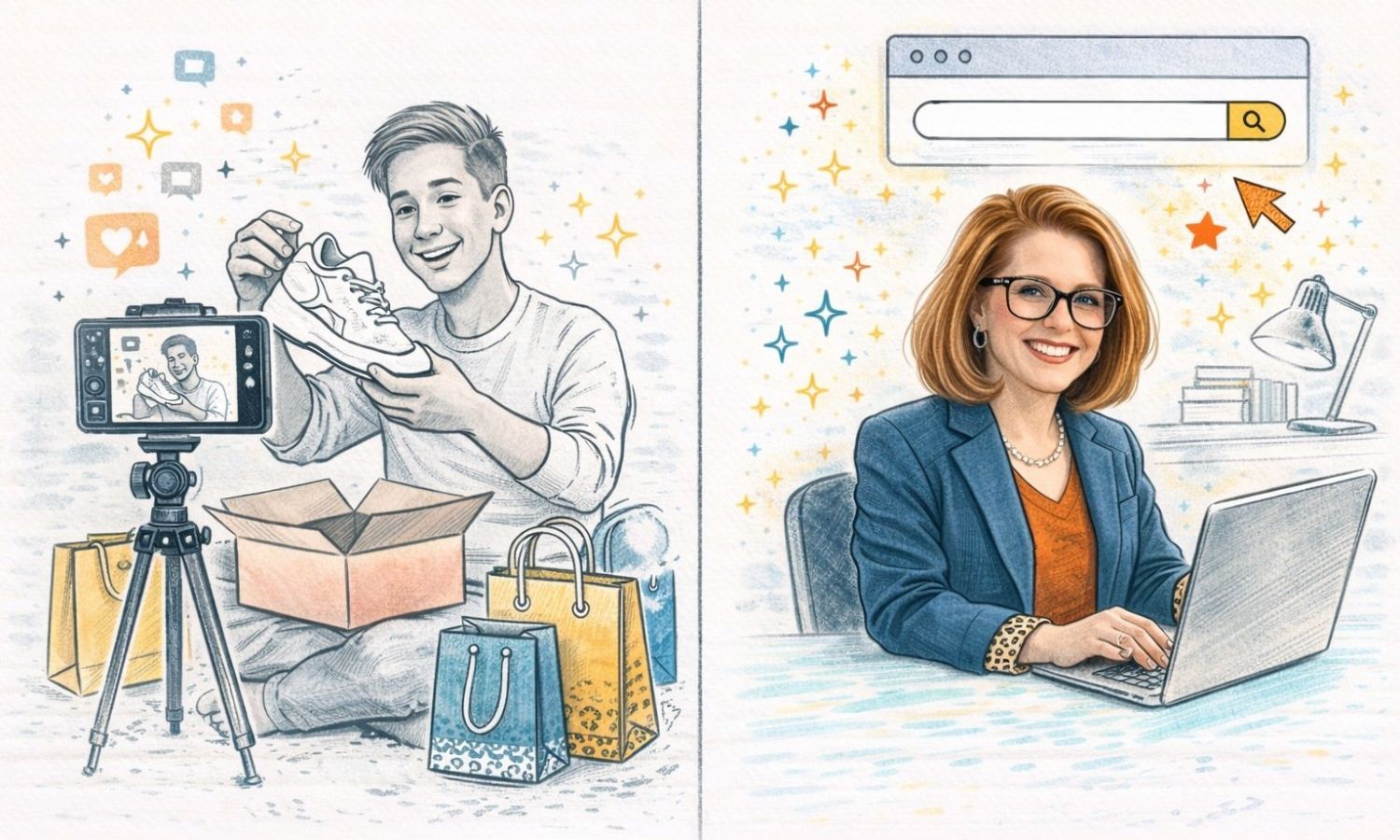
Service Businesses and Influencers Are Playing Two Different Games
There's a home organizer I know who posts tips and shortcuts on Instagram. She's good at what she does. She films quick videos showing how to organize a closet in 15 minutes, how to declutter a pantry, how to set up a system for incoming mail. She's built a following, and she makes affiliate income when viewers buy the products she recommends.
But nobody watches her organizing tips and then calls her to come organize their home. That's not how the content converts for a service business.
The data backs this up. Sprout Social surveyed over 2,200 social media users and found that 76% say social media content influenced a purchase in the last six months. That sounds like proof that social media works. Until you look at what people are buying. The top categories consumers search for on social media are cooking and recipe inspiration, TV and movie recommendations, music discovery, beauty, fashion, and travel. Product categories, all of them. "Find me a local security company" and "who should I hire to organize my house" are not on that list.
Search engines, on the other hand, are the number one source of business leads at 27%, ahead of social media at 20%. And the gap is even wider for local service businesses. People don't scroll Instagram looking for a plumber or an alarm company. They search for one. As one digital marketing CEO who specializes in local businesses put it: most prospects aren't seeking local service providers while scrolling social media. His recommendation for service businesses is to start with search, because that's where the intent lives.
If you're an influencer selling a product, the content itself is the sales channel. Someone watches your Reel, clicks your link, buys the thing. The metrics that matter are views, engagement rate, and click-throughs. That model works for products and affiliate income.
If you're a service-based business, the content does something different. It builds familiarity. It builds trust. And if it's structured correctly, it shows up when someone searches for help with the problem you solve. That last part is the one most business owners miss entirely, because it doesn't show up in your Instagram insights.
Social Media Engagement Is Declining, and That's Not Even the Real Problem
Buffer analyzed over 52 million posts across major platforms and published their findings in March 2026. Instagram's median engagement rate dropped 26% in a single year. Comments per post fell 16% on Instagram and 24% on TikTok. Across the board, audiences are scrolling more and interacting less.
There are a lot of theories about why. Content saturation. AI-generated content flooding every feed. Algorithm changes that prioritize paid reach over organic. General fatigue with the scroll itself.
Whatever the reason, the trend is clear. If you're measuring your content's value by engagement metrics, the numbers are going to disappoint you, and that disappointment is going to get worse every quarter.
But here's what I want you to consider: engagement was never the right metric for a service business in the first place. Even when likes were higher, those likes weren't turning into phone calls for most service providers. The metric was always a mismatch. The declining numbers just made it impossible to ignore.
Why YouTube for Business Works Differently Than Social Media
YouTube for business works differently because YouTube is not social media. It functions like a search engine, and it's the second largest search engine in the world, owned by the first.
When you publish a video on YouTube, the platform generates a text transcript of everything you said. Google indexes that transcript the same way it indexes a blog post or a web page. That means your YouTube video can show up in Google search results for the questions your ideal clients are typing in.
It gets bigger than Google. AI tools like ChatGPT, Perplexity, and Google's AI Overviews read YouTube transcripts when someone asks for a business recommendation or expert guidance. They're not watching your video. They're reading your words. And if your content answers the question clearly and specifically, you become part of the answer AI delivers.
That's what YouTube for business actually does. It makes your expertise findable by both search engines and AI, and it does it automatically from the moment you publish.
Compare that to a social media post. An Instagram Reel has a shelf life measured in hours. A YouTube video enters a search index and can bring you clients two years from now, because it answered a question someone typed into Google this morning.
Google Is Indexing More Content Than You Realize
Since July 2025, Google has been indexing public posts from Instagram Business and Creator accounts. That means your Instagram captions, Reels, and carousel text are now searchable on Google. This is a meaningful shift, and it's one more reason to think about your content as a search asset rather than a social media post.
But YouTube has been doing this from day one. YouTube content was indexable, searchable, and readable by AI before any of these changes happened. If you're trying to decide where to spend your time, that distinction should simplify the decision.
I introduced the Authority Web framework to help business owners build a system around this reality. One YouTube video becomes the parent piece of content. That one video gets repurposed into 25 to 30 pieces across every platform where your ideal clients are searching. YouTube sits at the center because it feeds both search engines and AI with the most complete, indexable content available.
If you're new to this idea, I covered the shift from traditional SEO to answer engine optimization in an earlier post. The short version: the question is no longer just "can Google find me?" It's "when someone asks an AI who to trust in my space, am I the answer?"
What to Measure Instead of Likes
If likes aren't the right scoreboard, what is? For service business owners using YouTube for business, there are better indicators that your content is doing its job.
YouTube Studio gives you search terms that people used to find your videos. That report tells you whether your content is matching the questions your ideal clients are asking. It's more useful than any engagement metric on any social platform.
YouTube also shows you traffic sources. If a growing percentage of your views come from YouTube search and Google search rather than browse features or suggested videos, your content is working as a search asset. That's the signal that matters.
Beyond YouTube, you can search your own topics in ChatGPT or Perplexity and see whether your content appears. If AI tools are citing you when someone asks about the problem you solve, your content is doing exactly what it should be doing, regardless of what your like count says.
If you're wondering where to start, I wrote a practical guide on YouTube strategy for business owners that walks through the first steps. And if you're still on the fence about whether YouTube is worth your time, this post on starting a YouTube channel for your business addresses the most common hesitations I hear.
The Content You're Already Creating Might Be Doing More Than You Think
The business owners I work with are often surprised when I show them where their content is actually showing up. They post a video thinking 200 views is a failure, and then we find the transcript indexed on Google for a search term their ideal client uses every week.
The content was working. They just weren't looking in the right place.
That's the shift this article is really about. Not "post more." Not "try harder." Just start measuring what actually matters for a service business, and put your energy into the platform that was built to make your expertise findable.
YouTube for business isn't a trend. It's a search engine that happens to play video. And for established business owners who already have deep expertise, it's the platform that rewards substance over performance.
What is the best social media platform for a service-based business?
YouTube is the strongest content platform for service-based businesses because it functions as a search engine. Every video generates a searchable transcript that Google indexes and AI tools read. Unlike social media posts that expire in hours, YouTube content can generate leads for years.
How do I know if my content marketing is working?
For service businesses, look at search visibility rather than likes. Check your YouTube traffic sources for search-driven views. Search your own topics in AI tools like ChatGPT. If your content shows up when someone searches for the problem you solve, it's working.
Why is social media engagement declining in 2026?
Buffer's analysis of 52 million posts found Instagram engagement dropped 26% year-over-year and comments fell 16%. Contributing factors include content saturation, AI-generated content flooding feeds, algorithm changes favoring paid reach, and general audience fatigue with scrolling.
What is answer engine optimization for business owners?
Answer engine optimization means structuring your content so AI tools like ChatGPT, Perplexity, and Google AI Overviews can find it, read it, and cite it when someone asks a question in your area of expertise. YouTube for business supports AEO because transcripts are automatically readable by AI systems.
How does YouTube for business connect to answer engine optimization?
YouTube automatically generates a text transcript of every video. That transcript is indexed by Google and readable by AI answer engines. When someone asks an AI tool for a recommendation in your space, your YouTube content is part of what it draws from to form its answer.
Get the Free Start Smart on YouTube Course
If you're ready to stop guessing about whether your content is working and start building on the platform that was designed for search, the Start Smart on YouTube course walks you through the S.I.M.P.L.E. YouTube Strategy in your own time. It's free, and it's built for business owners who already have the expertise and just need the system.
Get the Strategy That Works While You Work
One email per week. No trends to chase. Just YouTube strategy built for business owners who would rather be found than famous. Written by Kathy Sizemore, YouTube Strategist for Business Owners, from nearly 30 years of running a real business.
No spam. No daily posting advice. Just real strategy from someone who actually runs a business. You can unsubscribe anytime, but you probably won't want to.
Author