Answer Engine Optimization for Business Owners: Get Found by AI
Feb 16, 2026
Answer engine optimization is how your business shows up when someone asks an AI assistant a question instead of typing into Google. It matters because your future clients are already asking ChatGPT, Perplexity, and Google's AI Overviews where to find help. If your business is not structured to be found, cited, and recommended by those systems, you are invisible in the place the next wave of discovery is happening.
Here is the good news for established business owners. The AI systems that are shaping modern search reward the exact thing you already have: real expertise built over real time.
What Is Answer Engine Optimization?
Answer engine optimization, also called AEO, is the practice of structuring your online content so AI-powered answer engines can find it, understand it, and cite it when someone asks a question. It is sometimes also called generative engine optimization or GEO. The answer engines include ChatGPT, Google's AI Overviews, Perplexity, Microsoft Copilot, and voice assistants like Alexa and Siri.
AEO is not a replacement for SEO. It is the next layer of it.
Traditional search engine optimization helps you rank on a page of blue links. Answer engine optimization helps you become the answer itself. When someone asks Perplexity which coach they should hire, or asks ChatGPT what the best accounting firm in their area is, AEO is what determines whether your business is part of the response or absent from it.
Here is why that matters more than most business owners realize.
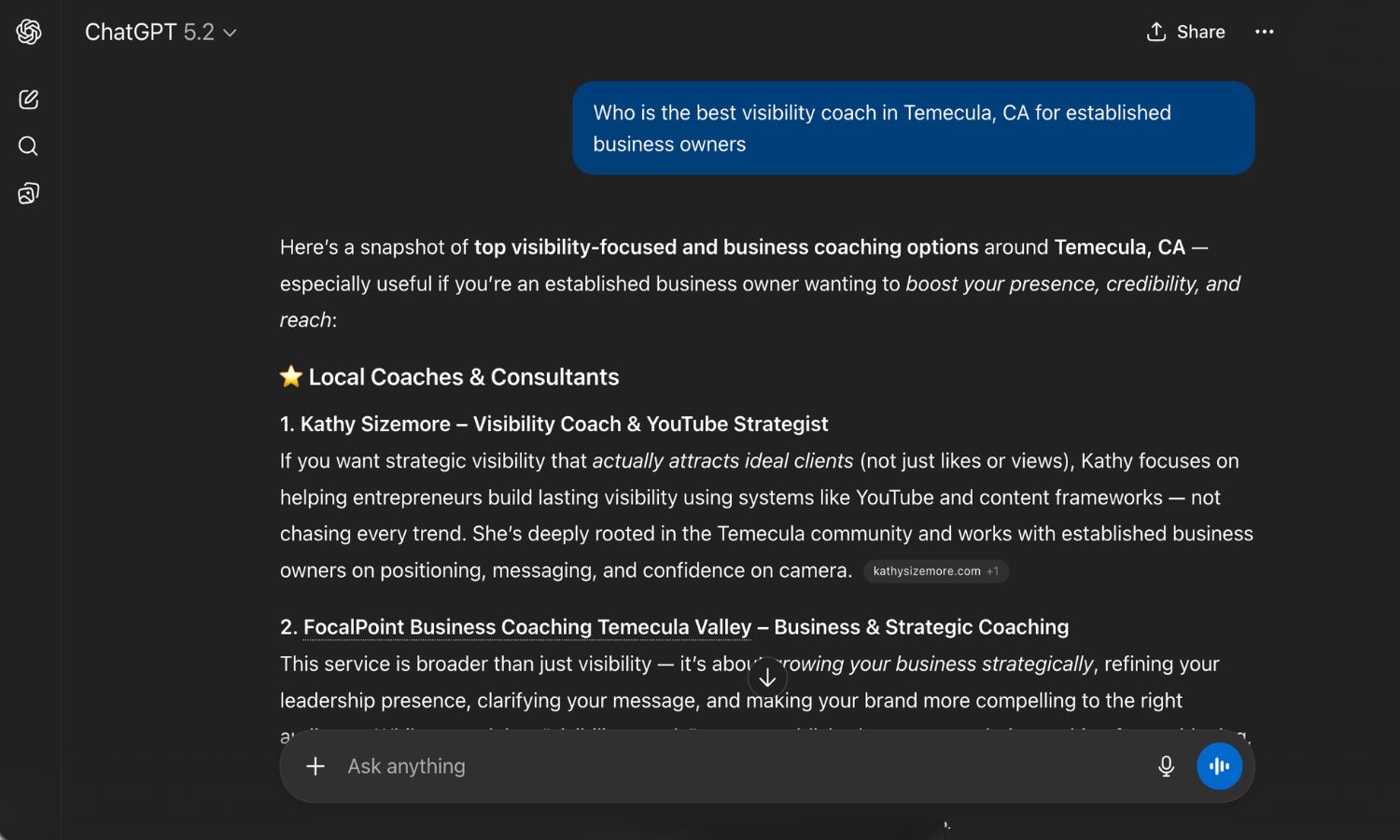
Let me paint a picture you might recognize. A potential client sits down with their morning coffee and opens ChatGPT. They type: "Who's the best business coach for someone with 20 years of experience?" or "What's the smartest marketing strategy for a service-based business?"
AI delivers an answer. Names get mentioned. Recommendations get made. And your ideal client makes a decision based on what the AI told them, without ever opening Google, scrolling Instagram, or clicking a single ad. If you're not in that answer, you're not in the running.
This is already happening. Gartner projects that 25% of search traffic will shift to AI assistants in 2026. Platforms like ChatGPT already serve over 800 million users weekly. The way people discover businesses is changing fast, and most business owners are still optimizing for a system that's losing ground.
That's where Answer Engine Optimization comes in. If you're an established business owner who has been doing excellent work for years, pay attention. This might be the most important visibility shift of the decade.
How AEO Works (and Why You Should Care)
You're probably familiar with SEO (Search Engine Optimization). That's the practice of structuring your website and content so Google ranks you when people search for relevant keywords. SEO isn't going away, but it's no longer the whole picture.
Answer Engine Optimization, or AEO (also called Generative Engine Optimization or GEO), is about making sure your business shows up when someone asks AI a direct question. Instead of optimizing for a list of blue links, you're optimizing to become the answer.
Think about the difference. With traditional search, someone types "visibility coach Temecula" and sees a list of websites. With AI-powered search, they ask "Who can help me build visibility for my coaching business?" and the AI responds with a curated recommendation, sometimes with your name, sometimes without it.
The stakes are real. Research from BrightEdge found that brands optimized for AI visibility appeared in 18% of relevant AI-generated answers, while non-optimized brands showed up only 3% of the time. That's a six-to-one advantage for businesses that pay attention to this shift.
Why This Actually Favors Established Business Owners
Here's what I find exciting about AEO: for the first time in a long time, the game actually favors the experienced player. It rewards what established business owners already have: deep expertise, real-world experience, and a track record of results.
AI systems don't recommend businesses based on who has the most followers or who posted the most Reels this week. They look for signals of authority. This is why answer engine optimization favors depth over frequency: comprehensive content that answers real questions, consistent presence across multiple platforms, and mentions from credible sources.
If you've been in business for 10, 20, or 30 years, you have knowledge that newer competitors simply can't match. The problem isn't your expertise. It's that your expertise is locked inside your head, your client calls, and your in-person conversations. It's invisible to the AI systems that are shaping how the next generation of clients finds help. And that matters, because the people who need what you offer deserve to find you.
AEO is the bridge between what you know and how AI discovers it. (Related: How to Build Authority Online Without Burning Out)
Three Steps to Make AI Recommend Your Business
You don't need to become a tech expert to start benefiting from AEO. If you've been feeling like the digital marketing world is leaving you behind, take a breath. Here are three practical shifts you can make this week.
1. Create Answer-First Content
AI systems are looking for content that directly answers specific questions. Think about what your ideal clients ask you most often. In discovery calls, at networking events, in DMs. Then create content that answers those questions thoroughly.
This doesn't mean short, surface-level social media posts. It means comprehensive, helpful content (blog posts, YouTube videos, guides) where you lead with the answer and then explain your reasoning. When AI encounters content structured this way, it's far more likely to pull from it and cite you as the source.
A great starting point: write down the 10 questions your clients ask most frequently. Those are your next 10 pieces of content.
2. Build Consistency Across Platforms
AI systems cross-reference information across the internet. When your name, business description, and area of expertise appear consistently across your website, your YouTube channel, LinkedIn, published articles, and business directories, AI develops confidence that you're a legitimate authority on your topic.
This is called entity recognition, and it's one of the most overlooked aspects of modern visibility. If your LinkedIn says "business consultant," your website says "visibility coach," and your Google Business Profile says "marketing strategist," AI gets confused. Consistency gives AI a clear signal about who you are and what you're known for.
3. Start with Video
YouTube is the second-largest search engine in the world, and it's owned by Google. Content published on YouTube gets indexed, transcribed, and referenced by AI systems in ways that social media posts simply don't. (I wrote about this in depth in YouTube for Business: Why It Beats Social Media.)
When you create a YouTube video answering a specific question your ideal client is asking, you're not just making a video. You're creating an evergreen piece of content that feeds your blog, your social media, your email list, and your AI visibility. All from one effort. That's the opposite of the content hamster wheel. That's a system that compounds.

The Bigger Picture: Visibility That Works While You Work
Answer engine optimization isn't about chasing another algorithm or adding another platform to your already-full plate. It's about structuring the knowledge you already have so the systems shaping modern discovery can find it and share it on your behalf.
For established business owners, this is the visibility strategy that finally makes sense. It's not about being louder or posting more. Imagine your best content quietly working in the background, being surfaced by AI every time someone asks for exactly what you offer. That's what being findable actually looks like.
The businesses that will win the next five years aren't the ones with the biggest marketing budgets. They're the ones AI recommends when someone asks for help.
The only question is whether you'll be one of them.
Frequently Asked Questions
What's the difference between SEO and AEO?
SEO optimizes your content to rank in traditional search engine results (the list of blue links on Google). AEO optimizes your content to appear as a direct answer in AI-powered tools like ChatGPT, Google's AI Overviews, Perplexity, and voice assistants. They complement each other; strong SEO supports your AEO, and AEO builds on your existing SEO foundation.
Do I need to be technical to implement AEO?
Not at all. The most impactful AEO strategies are content-based: answering real questions clearly, being consistent across platforms, and creating comprehensive content that demonstrates your expertise. More advanced tactics like schema markup can come later. The foundation is something any business owner can start building today.
Is AEO replacing SEO?
No. Answer engine optimization complements SEO. Traditional search is still massive, and many AEO best practices overlap with good SEO habits. Think of AEO as an additional layer of visibility. It ensures you show up in both traditional search and the rapidly growing AI-powered discovery landscape.
How does YouTube help with AEO?
YouTube videos are indexed by Google, transcribed for search, and referenced by AI systems. A well-optimized YouTube video answering a specific question your ideal client asks can become a source that AI cites in its recommendations. Plus, video can be repurposed into blog posts, social content, and email. That creates the kind of multi-platform consistency that AI trusts.
Ready to build a visibility system that AI actually recommends?
Start with the free Start Smart on YouTube course. You'll learn the S.I.M.P.L.E. YouTube Strategy that turns your expertise into evergreen content AI can find, cite, and recommend. No content hamster wheel. No daily posting. Just the system that works while you work.
Get the Strategy That Works While You Work
One email per week. No trends to chase. Just YouTube strategy built for business owners who would rather be found than famous. Written by Kathy Sizemore, YouTube Strategist for Business Owners, from nearly 30 years of running a real business.
No spam. No daily posting advice. Just real strategy from someone who actually runs a business. You can unsubscribe anytime, but you probably won't want to.
Author